> ## Documentation Index
> Fetch the complete documentation index at: https://docs.nebuly.com/llms.txt
> Use this file to discover all available pages before exploring further.
# AI proficiency
> Measure how well your employees prompt AI agents, turning prompt quality into a single trackable score.
Most organizations have invested heavily in AI assistants, but very few can answer a simple question:
> **Are our employees actually good at using AI?**
Today, most companies measure AI adoption through metrics such as licenses, active users, conversation volume, or training completion. While these metrics indicate that employees are using AI, they say little about **how effectively** they are using it. Industry research increasingly highlights that AI literacy—not simply AI access—is one of the biggest factors determining whether organizations realize a return on their AI investments.
Poor prompting has real business consequences. Employees who struggle to communicate with AI typically require more conversation turns, generate more retries, receive lower-quality outputs, and spend more time completing the same tasks. As a result, organizations see lower productivity and reduced ROI, even when AI adoption appears high.
AI Proficiency closes this visibility gap by providing a measurable indicator of how effectively employees interact with AI. Instead of measuring **whether** employees use AI, it measures **how well** they use it.
With AI Proficiency, you can:
* Measure AI prompting skills across your organization.
* Identify teams and individuals who excel at using AI, and those who would benefit from additional training.
* Compare AI proficiency across teams, projects, or business units.
* Track improvements over time after training or AI adoption initiatives.
* Connect workforce capability with business outcomes such as productivity and AI ROI.
Rather than relying on assumptions or usage metrics alone, AI Proficiency gives you a data-driven view of your organization's AI capabilities, helping you continuously improve how employees work with AI.
## How the AI Proficiency score works
Each employee interaction is scored across six dimensions, then combined into one weighted score from 0 to 100.
The **AI Proficiency** score (also referred to as the **AI Fluency Index**) measures how effectively users interact with AI agents. It evaluates the quality of each prompt and converts it into a score from **0 to 100**, helping organizations understand how well employees use AI and where additional training may be needed.
| Dimension | Weight | What it looks at |
| ---------------------------- | ------ | --------------------------------------------------------------------------------------------------------- |
| **Task clarity** | 30% | Is the goal explicitly and precisely stated? (`summarize this contract in 3 bullet points` vs. `help me`) |
| **Context provision** | 25% | Does the user give relevant background such as role, constraints, or data? |
| **Output specification** | 20% | Does the user specify format, length, or structure? (`as a table`, `in 2 sentences`, `as JSON`) |
| **Prompt length** | 10% | Word count of the prompt. |
| **Conversation efficiency** | 10% | How few turns were needed to reach a resolution. Fewer turns scores higher. |
| **Constraint specification** | 5% | Are boundaries or exclusions given? (`don't include X`, `only use data from Y`) |
### Proficiency levels
Every employee is automatically classified into one of four levels based on their score.
| Level | Score range | What it means |
| ---------------- | ----------- | ---------------------------------------------------------------------------------- |
| **Expert** | 85 to 100 | Multi-part prompts, role instructions, defined output format, uses constraints |
| **Practitioner** | 65 to 84 | Clear task, some context, minimal formatting, occasional correction turns |
| **Beginner** | 40 to 64 | Task is vague, little context, no format, needs multiple correction turns |
| **Novice** | 0 to 39 | One-line prompts, no context, no format, high retry rate. Priority training target |
## The AI Proficiency report
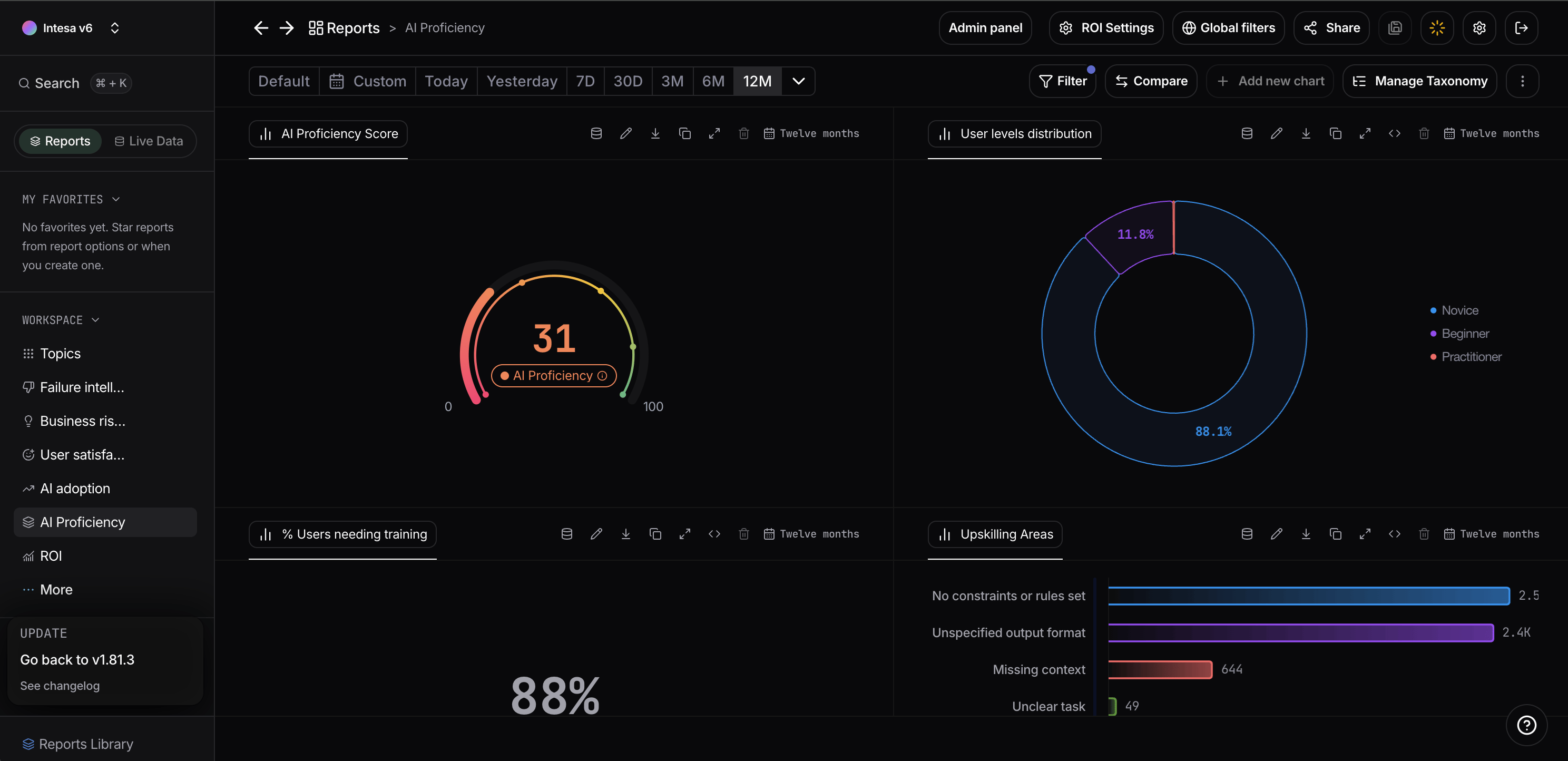
Nebuly **AI Proficiency** report provides an overview of AI proficiency across your organization.
AI Proficiency is not enabled by default. To activate it, contact your Nebuly account team.
It includes four key visualizations:
#### AI Proficiency Score
Shows the overall AI proficiency score for your workspace. Use it to measure your organization's AI maturity and track improvements over time.
#### User levels distribution
Shows how users are distributed across the four proficiency levels: **Expert**, **Practitioner**, **Beginner**, and **Novice**. It helps you understand the overall skill distribution of your workforce.
#### Users needing training
Displays the percentage of users who would benefit from additional AI training, making it easy to monitor the impact of enablement initiatives.
#### Upskilling areas
Highlights the prompting skills that most frequently reduce proficiency scores, such as **unclear tasks**, **missing context**, **unspecified output formats**, or **missing constraints**. Use it to identify the skills your organization should focus on improving.
#### Upskilling areas by topic
Breaks down these skill gaps by business topic, helping you understand **where** employees struggle the most and prioritize targeted training or prompt templates for specific use cases.
 ## Build your own reports
All AI Proficiency metrics and dimensions are available throughout Nebuly's reporting engine, allowing you to build custom reports tailored to your needs.
You can use AI Proficiency scores, proficiency levels, and individual prompting attributes alongside existing metrics, filters, and groupings to answer questions such as:
* Which departments have the highest AI proficiency?
* How has proficiency changed over time?
* Which AI agents generate the most proficient users?
* Which teams struggle with missing context or unclear tasks?
By combining AI Proficiency with the rest of your workspace data, you can create reports that measure AI fleuncy, identify training opportunities, and track improvements across your organization.
## Build your own reports
All AI Proficiency metrics and dimensions are available throughout Nebuly's reporting engine, allowing you to build custom reports tailored to your needs.
You can use AI Proficiency scores, proficiency levels, and individual prompting attributes alongside existing metrics, filters, and groupings to answer questions such as:
* Which departments have the highest AI proficiency?
* How has proficiency changed over time?
* Which AI agents generate the most proficient users?
* Which teams struggle with missing context or unclear tasks?
By combining AI Proficiency with the rest of your workspace data, you can create reports that measure AI fleuncy, identify training opportunities, and track improvements across your organization.