> ## Documentation Index
> Fetch the complete documentation index at: https://docs.nebuly.com/llms.txt
> Use this file to discover all available pages before exploring further.
# Filtering
> Navigate conversational datasets with global and local filters, keyword search, saved filters, and favorites.
Nebuly's filtering provides a way to navigate conversational datasets in order to surface and visualize specific subsets of conversations. You can easily find, count and analyze subsets of conversations without requiring exact terminology. Nebuly lets you segment each set and view by all available fields, from automatically detected topics or intents, to custom set attributes or subgroups of users.
## Global vs local filters
There are two levels of filtering in Nebuly:
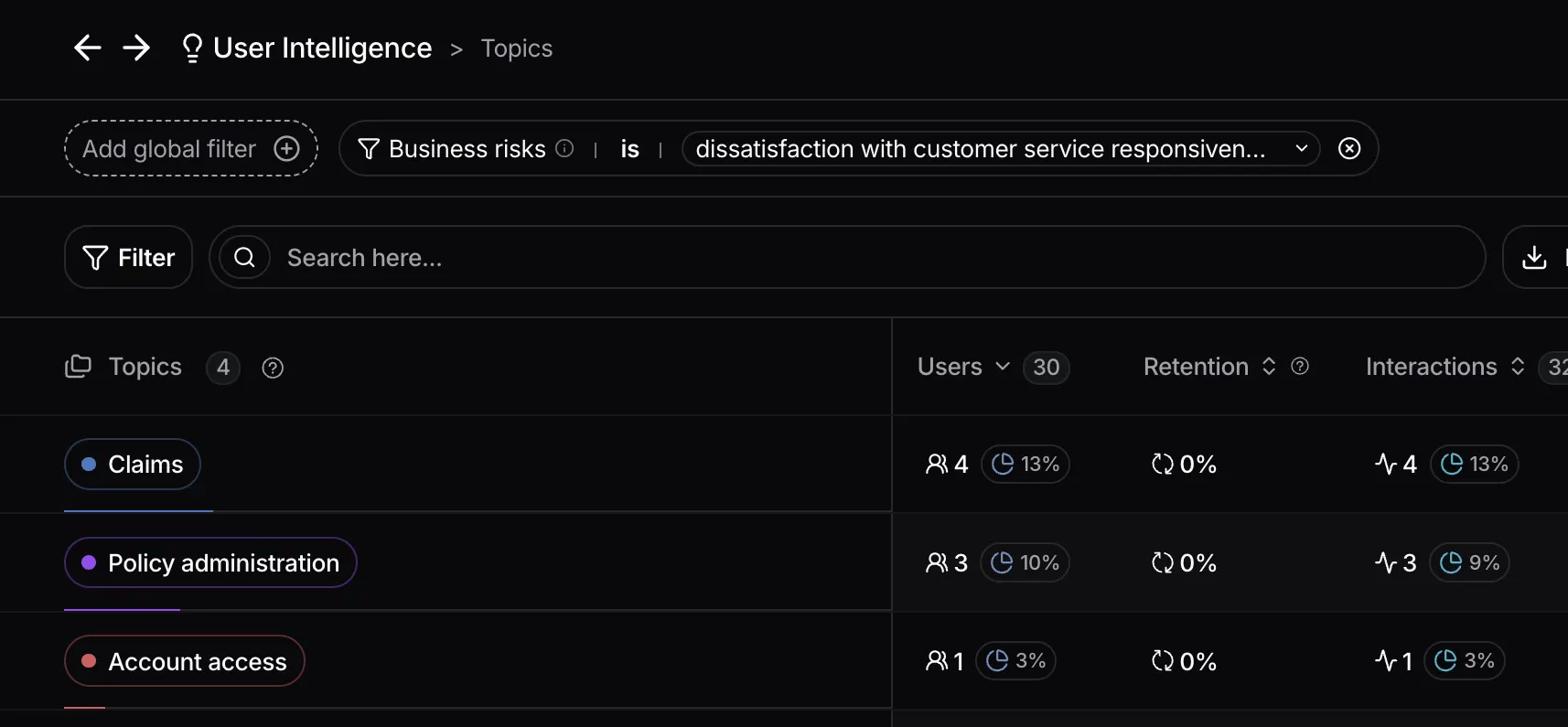
* **Global filters** live in the top bar and apply across the whole platform. They stay active as you move between pages, so every view reflects the same selection until you change it. This is the right level when you are investigating one segment across reports and Live Data at the same time. For where the global filter bar sits in the interface, see [Navigating Nebuly](/guides/navigating-nebuly).
* **Local filters** apply to a single chart or list view only. Use them when you want to narrow one chart or table without changing what you see everywhere else.
 ## Filtering reports and lists
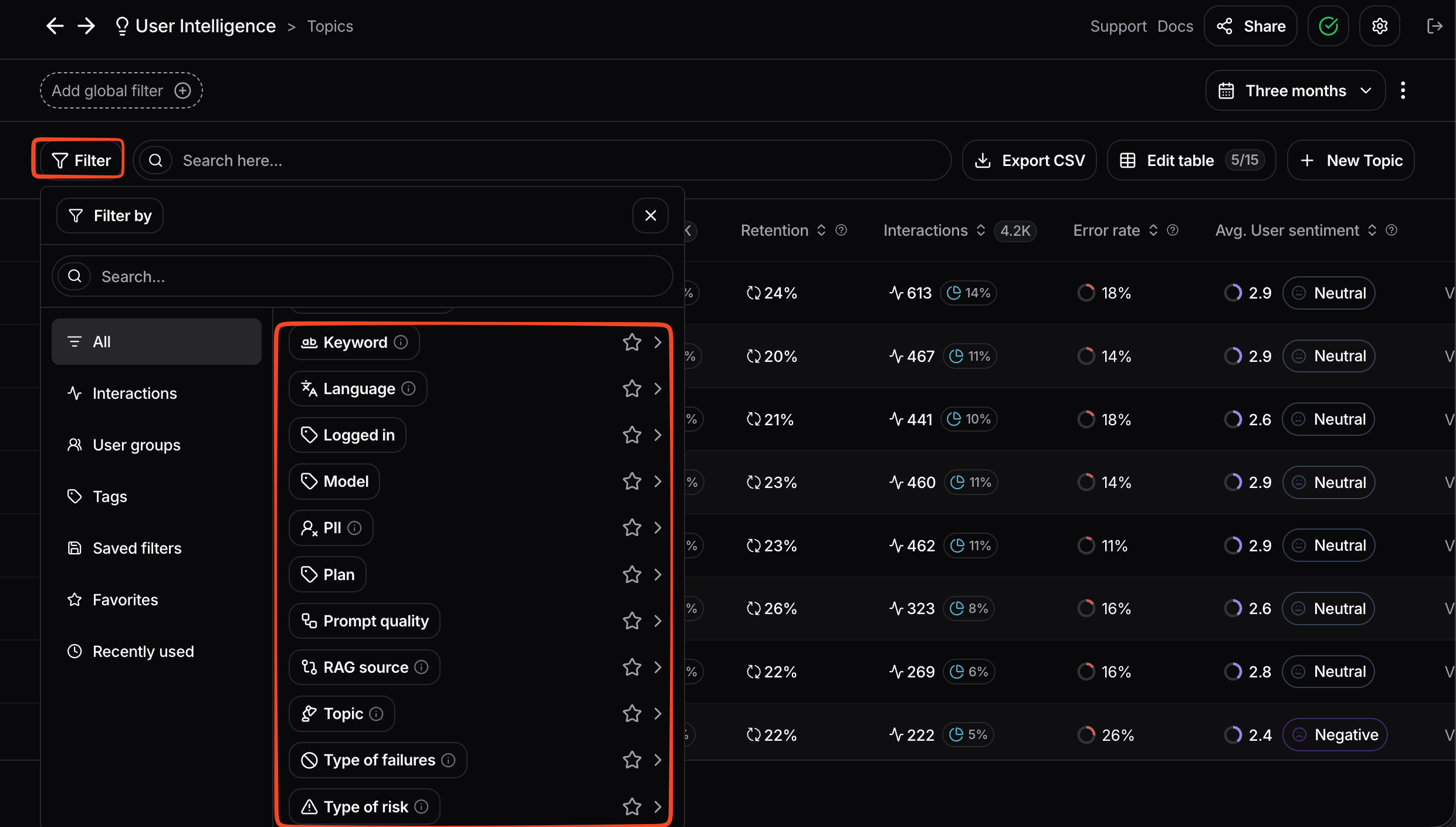
All views in Nebuly can be filtered by **any** attribute on an interaction or conversation. This includes built-in fields (topics, intents, sentiment, error type, business risks, user feedback) and every custom tag you sent at ingestion.
Nebuly supports **100+ filter options**. Common examples include **Topic** (the main theme of the interaction), **Action** (the task the user is trying to do), **Sentiment**, **Language**, **User** (a specific user ID), **RAG Source**, **Frustration reason**, and any custom **tag** you sent at ingestion.
For the definitions behind these fields, see [Nebuly Data Types](/guides/data-types). Custom tags are configured at ingestion, see [Enrichment and the importance of tagging](/guides/enrichment-and-tagging).
## Filtering reports and lists
All views in Nebuly can be filtered by **any** attribute on an interaction or conversation. This includes built-in fields (topics, intents, sentiment, error type, business risks, user feedback) and every custom tag you sent at ingestion.
Nebuly supports **100+ filter options**. Common examples include **Topic** (the main theme of the interaction), **Action** (the task the user is trying to do), **Sentiment**, **Language**, **User** (a specific user ID), **RAG Source**, **Frustration reason**, and any custom **tag** you sent at ingestion.
For the definitions behind these fields, see [Nebuly Data Types](/guides/data-types). Custom tags are configured at ingestion, see [Enrichment and the importance of tagging](/guides/enrichment-and-tagging).
 ## Keyword search
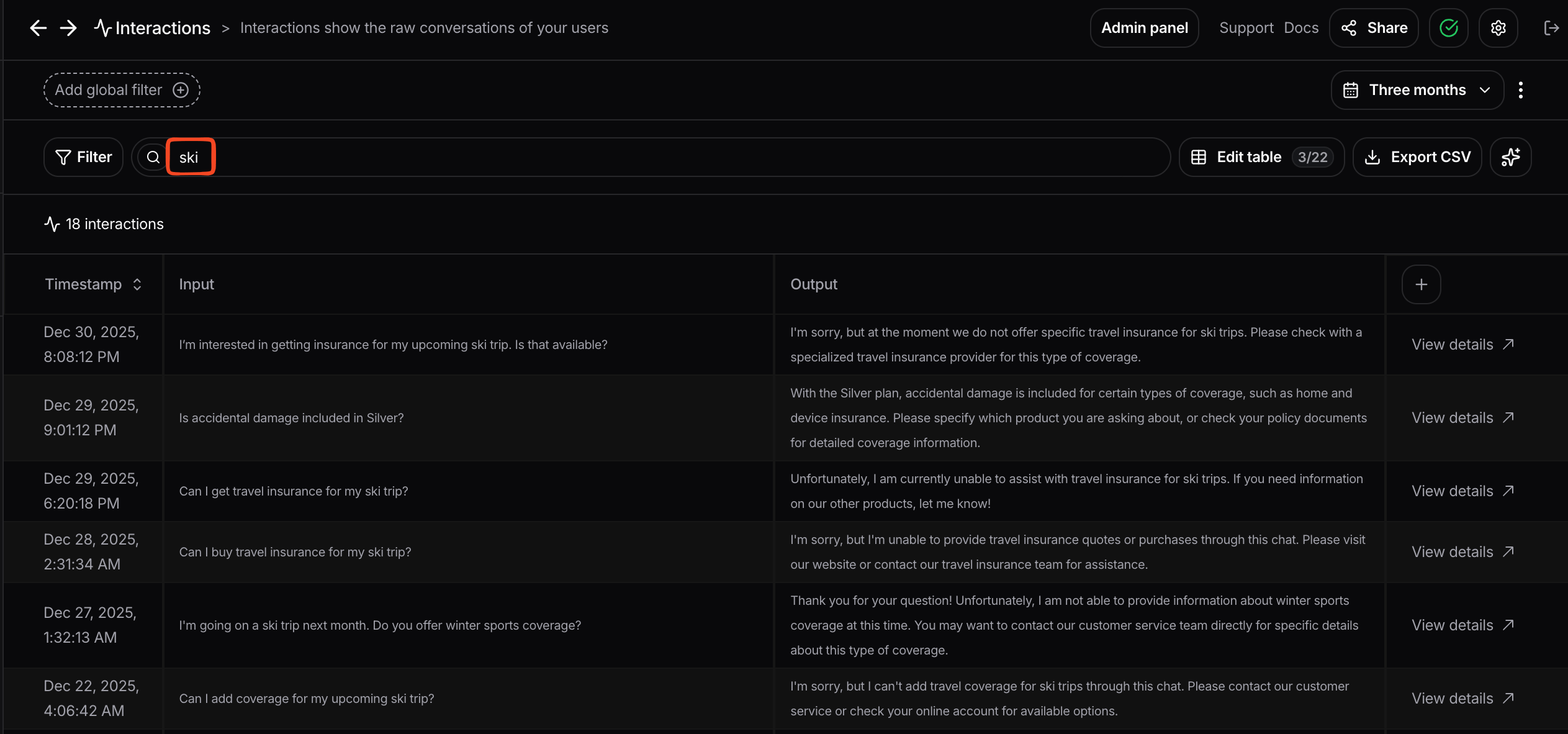
On each list view, a search bar is available to quickly and easily search for keywords in large datasets, like the interactions view seen below.
## Keyword search
On each list view, a search bar is available to quickly and easily search for keywords in large datasets, like the interactions view seen below.
 ## Saved Filters
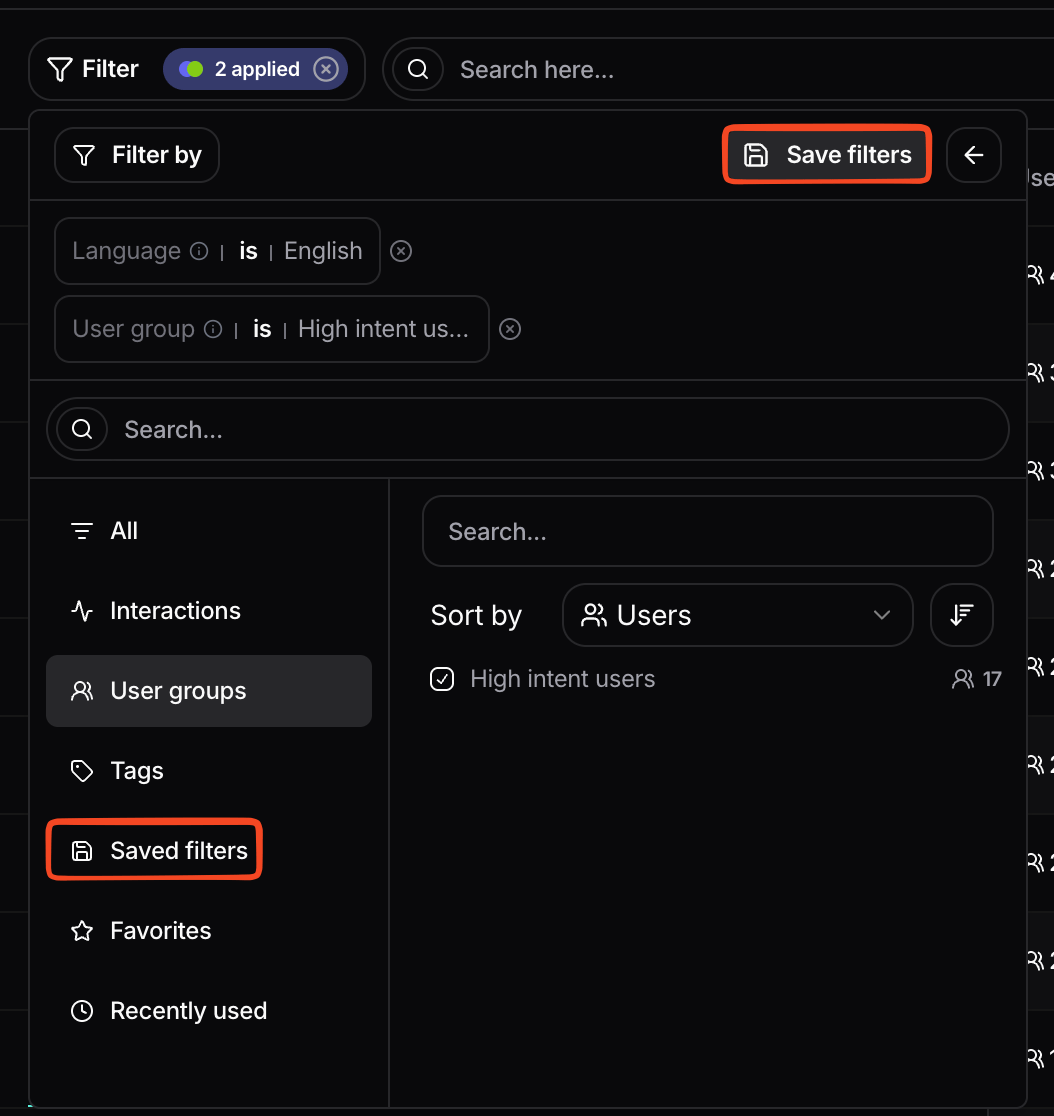
Often-used combinations of filters can be saved for reuse across future sessions.
To save a combination, click **Save filters** in the filter selection panel and give the saved filter a descriptive name. You can then apply the saved filter at any time from the **Saved filters** section of the filter selection panel.
The Saved filters list is **shared across all users in the project**, which makes it a lightweight way to standardize how your team slices data.
## Favorites
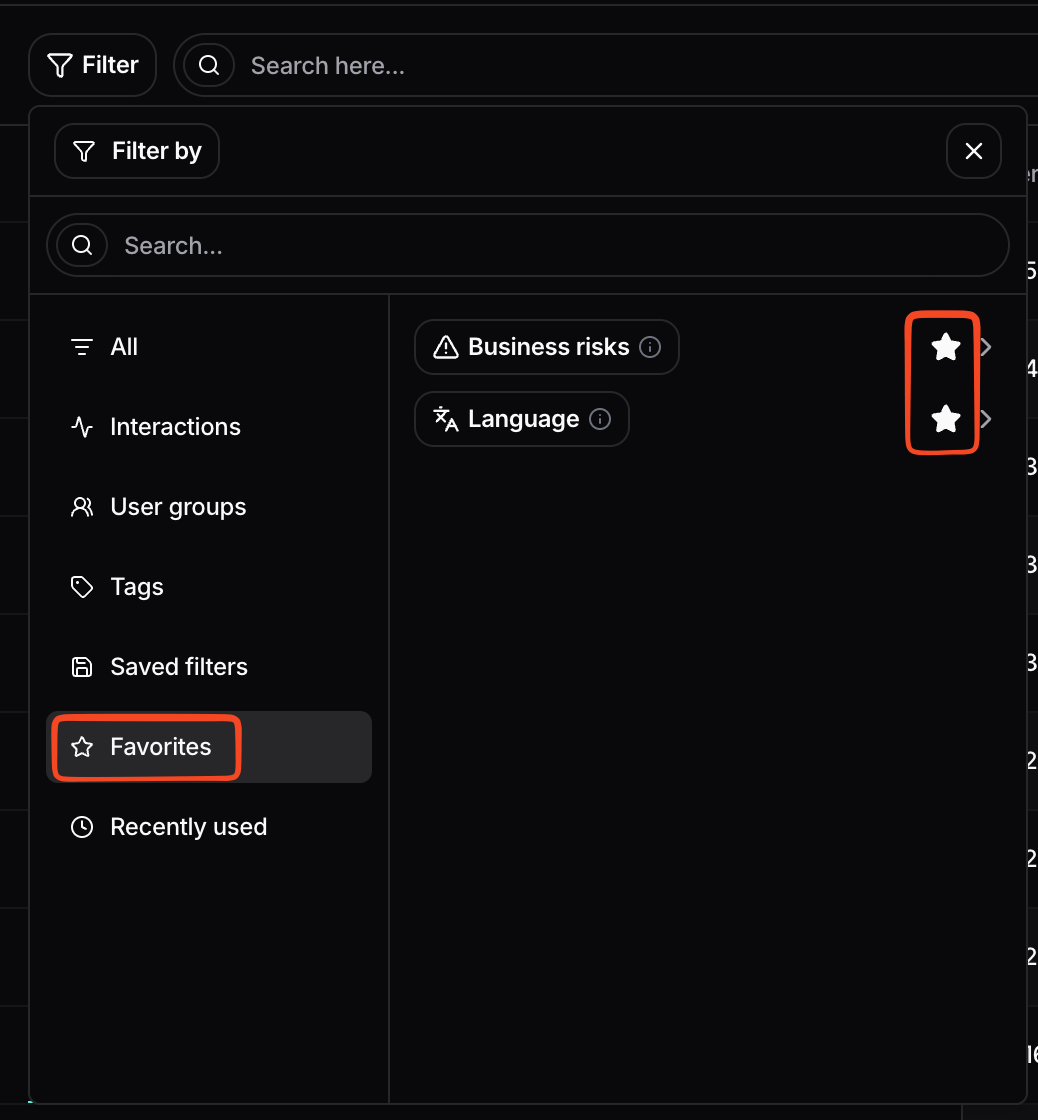
To make your most-used filtering fields easier to find, mark them as favorites by clicking the star next to a field. Your starred fields then appear at the top of the filter selection panel under **Favorites**.
This list is **individual to each user**: each teammate maintains their own favorites without affecting anyone else.
## Filtering inside Reports
The same fields drive chart configuration in Reports. When building a chart, **Filter** narrows the dataset a metric is computed on, and **Group by** splits the metric along one of these dimensions. Saved filter sets are available there too. For how filters, variables, and group-by combine in a chart, see [Reports](/guides/reports-guide).
## Saved Filters
Often-used combinations of filters can be saved for reuse across future sessions.
To save a combination, click **Save filters** in the filter selection panel and give the saved filter a descriptive name. You can then apply the saved filter at any time from the **Saved filters** section of the filter selection panel.
The Saved filters list is **shared across all users in the project**, which makes it a lightweight way to standardize how your team slices data.
## Favorites
To make your most-used filtering fields easier to find, mark them as favorites by clicking the star next to a field. Your starred fields then appear at the top of the filter selection panel under **Favorites**.
This list is **individual to each user**: each teammate maintains their own favorites without affecting anyone else.
## Filtering inside Reports
The same fields drive chart configuration in Reports. When building a chart, **Filter** narrows the dataset a metric is computed on, and **Group by** splits the metric along one of these dimensions. Saved filter sets are available there too. For how filters, variables, and group-by combine in a chart, see [Reports](/guides/reports-guide).